Silicon Valley 101 E183: Bitcoin Whale Strategy, MicroStrategy
This podcast talked about how the US-listed company MicroStrategy operates. The company issues debt and raises financing to buy a large amount of Bitcoin, providing greater liquidity compared with a BTC ETF. Because it has built-in high leverage plus high volatility, hedge funds and other players like to buy it. Also, it is a US stock, so a lot of capital that cannot buy ETFs, such as overseas pension funds and state funds, can buy it. Sanctioned countries are now also recommending holding more BTC reserves. The company’s CEO is extremely good at marketing, and the selling point he promotes is high volatility. Recently, in communications with the US government, he suggested that the US should build reserves beyond just Bitcoin.
The point that left a deeper impression on me was that the guest mentioned the meaning of on-chain economy at the end. In this era of intensified conflict between countries, whoever can dominate the on-chain economy will dominate the global economy. For example, CN controls capital outflow, but if there is a large on-chain economy, then liquidity can all run there. This guest also talked about Tether before. The company behind the USDT stablecoin means that the more stablecoins you buy, the more you are directly buying US Treasuries. Tether is already the 18th-largest holder of US debt, surpassing many countries. So to prevent dollar hegemony, some countries are also promoting their own on-chain transaction currencies. I think I may also need to get a cold wallet and hold some BTC, probably 5% to 10% of total assets. BTC may deviate from traditional value investing, but as the originator of the new on-chain economy, it has irreplaceable value.
So at the moment, although the US may not necessarily continue its technological hegemony, and domestically Emperor Trump and Musk are messing around while inflation is getting higher, dollar hegemony still has no replacement in the world.
Latent Space: Ji Yu, Who Trapped the AI Industry in a Mainframe-Like Computer Form, and the Possibility of Change
Official notes: https://miracleplus.feishu.cn/docx/SngpdNt4XoNXHvxzFkFcJNd5nGh
The author reviewed the history of artificial intelligence and explained that the scaling stage of large models is around L2 to L3. But its upper bound is here, because although o1 brought the paradigm of RL post-training, the current upper bound of large model capability is the upper bound of language as a complex system. The guest casually mentioned that complex systems can bring entirely new capabilities. For example, everyone knows the components that make up an individual person, but society, because of the interactions among many people, becomes a complex system and produces capabilities far beyond the composition of each person. Then the guest reviewed the PC era and the internet era, and found that the large model era lacks an ecosystem with “lower cost, complete functionality, and support for openness and compatibility”. In other words, it lacks a business model for the LLM era.
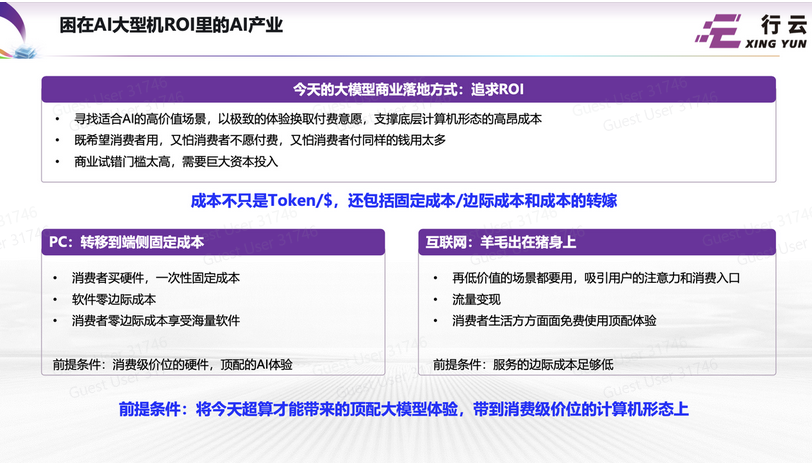
In the era from mainframes to personal computers, the microchip invented by Intel allowed everyone to access computers and the age of intelligence, and people only needed to buy once to keep using it afterward. In the internet era, the greatest invention was “the wool comes from the sheep”, also the greatest business model in human history: advertising. Users obtain services by selling attention, which gave rise to research on recommender systems. But at the moment, the business model of NVDA selling GPUs at a high premium and other companies selling tokens is clearly not as good as the previous two, so in the short term it cannot truly change the world. The author believes that buyers now think the cost is too high, while developers have very low ROI, so this supercomputing model needs to move to personal devices before a new era can begin. As for his own company, I did not listen too carefully, but this historical framing was especially interesting. On one hand, I really agree with his view. On the other hand, he also covered many things I had not thought about, such as the PC era.
High Energy 160-161: Reading the Government Work Report, the AI Talent War
The first episode interpreted the government’s report and emphasized the government’s focus on technology. I do not remember many specifics.
The second episode featured an AI recruiting company and talked about domestic companies’ pursuit of AI talent. In 2013, talent in the US was not willing to go back, because the treatment was bad: less money and more work. But since 2024, more and more talent has started to return. The overall trend has a bit of a Matthew effect. Giants are willing to spend huge money to compete for top talent, but slightly weaker talent does not have an easy time finding jobs. The guest predicted that second-tier talent may need to enter traditional companies. For example, a domestic rental software company attracted a wave of talent and carried out an AI transformation. Then the guest emphasized that the universe company ByteDance is sparing no cost, spending heavily to recruit people, and Zhang Yiming personally contacted many AI talents one-on-one.
My feeling is that I myself belong to the second-tier talent group, so I can really understand the guest’s point that only top talent can easily find jobs. So besides continuously learning and trying to become top talent, I also need to consider non-tech industries in the short term.
LatePost Talk 85: Building a Country from Nothing
Building a country from scratch is much harder than a web novel. Even with cheats on, it still takes many years.
People’s Park Talks AI: Doubao Is Only an Intermediate State of the Product
This talked about ByteDance’s Doubao/Coze developer conference. My impression is that ByteDance is indeed nb. It is willing to burn money and can afford to burn money. Product, research, talent, it is taking all of them. At the moment it feels like the only T0 in China. Alibaba is also decent. The other companies are a bit weak.
Hard Hacker 88: Building a Translation Product
The guest is a former PM from ByteDance who used ChatGPT to build a manga translation app and made it profitable.
Six-Way Intersection: The Emotional Value Pets Need Is Hard to Replace
An Alibaba executive left to start a company and build a dog food brand. He emphasized that entrepreneurship is harder, but psychologically more relaxing for himself, and the team is relatively loose. The guest emphasized the current bond between people and pets, and how a person’s beliefs affect their consumption of pet products. For example, if someone cares a lot about healthy eating, then when choosing dog food, they will also buy brands that emphasize healthy diet.
What’s Next: From DeepSeek to Manus
The female guest claimed to be a former OpenAI researcher, but listening to her, I felt her understanding of AI was extremely limited. For example, she lacked understanding of commercialization for open-source projects and did not know how open source actually makes money. She also had some obviously wrong technical views, such as “the API of an open-source model must be more expensive than self-deployment”. Although Teacher Xu and the male guest tried their best, the female guest took up too much time and could not be carried. Listening to it was almost the same as not listening.